
Today’s Contemplation: Collapse Cometh CCLIII–Peak Oil and the Architecture of Collapse, Part 2
Peak Oil and the Architecture of Collapse, Part 2

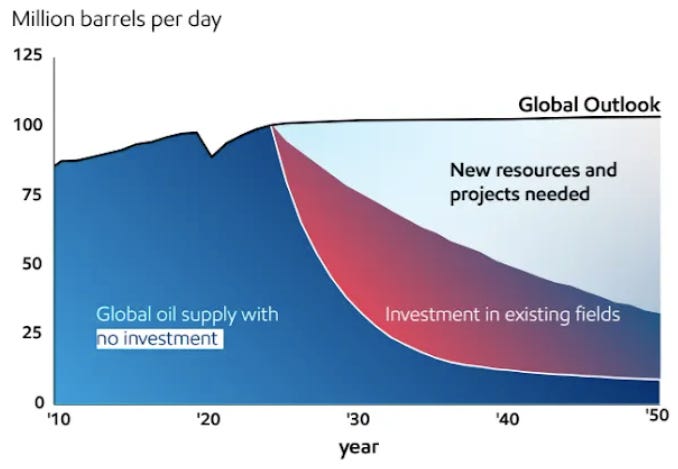
In Part One of this Contemplation (see: Website Medium Substack), I attempted to lay out the foundational components of humanity’s hydrocarbon predicament by looking at the geologic, energetic, and systemic realities. I asserted that hydrocarbons are not just one of a variety of factors influencing our journey, but the most important material resource upon which we have constructed a global, industrialised civilisation of enormous complexity. I tried to clarify what peak oil actually means and how it is not reflective of the peak-demand narratives that most people, but especially economists, suggest–a storyline that obscures the geologic reality that peak oil is. The technological salvation narratives that promise to save us from our master resource predicament have been examined and found wanting. Declining energy return on investment was explored and linked to archaeologist Joseph Tainter’s thesis regarding the collapse of complex societies. The conclusion of the above is somewhat sobering: our complex societies have been constructed via a finite resource that is beginning to decline in availability and with this reality will come challenges beyond perhaps anything humanity has yet encountered in its short timespan on the planet.
I now turn away from this foundation towards the challenges brought on by peak oil, and will examine how the decline of hydrocarbon availability will impact three critical areas: the agricultural system that provides the lion’s share of humanity’s food, the ever-growing human population we support, and the geopolitical landscape. The framework in biophysical economics established by Charles Hall and Robert Ayres will provide the backbone of my analysis; it holds that our economies are not separate from but a subsystem of our biosphere. From this perspective, economic activity is constrained by the laws of thermodynamics. This is a physical reality that no amount of techno-optimism or financial engineering can change.
The Petro-Agriculture Trap
Let me begin with the somewhat alarming dependence on hydrocarbons that we have established with our modern agricultural systems.
In about the mid-20th century humanity’s agriculture was transformed from a totally solar-powered endeavour to one almost entirely powered by hydrocarbon fuels. It was–quite ironically given the environmental destruction it has brought with it–called the “Green Revolution”, where we replaced human labour with machines, animal manure with synthetic fertilisers, crop rotation with chemical pesticides, and genetic diversity with monocultures. This “revolution” has allowed us to feed an expanding population but it has done so by trading ecological intelligence for hydrocarbons.
Our industrial food production system consumes about 10 calories of hydrocarbon energy for every calorie of food that is produced through it. This is an unsustainable situation given it is dependent upon the drawing down of a finite resource. All of the main inputs to maintain this system, and keep our ever-growing population fed, are hydrocarbon-dependent: diesel to power tractors, natural gas as feedstock for nitrogen fertiliser, oil for herbicides and pesticides, and liquid fuels to help power the processing, transportation, refrigeration, and packaging of food. Our modern food systems would collapse catastrophically without these hydrocarbon inputs.
Peak oil and its terminal decline in production have profound consequences for agriculture given its dependence upon hydrocarbons. Food costs will increase dramatically because of energy supply disruptions, even more so than they have in recent years. Food availability will become strained as global trade becomes less reliable. Just-in-time delivery systems will be challenged as the transport networks they depend upon face bottlenecks. Other problems will also arise with fuel and energy disruptions, such as with greenhouses that produce our out-of-season vegetables and cold chains that preserve our food.
And we are severely limited in the type of adaptations we might use to mitigate the disruptions. While organic agriculture has many virtues, its yields are much lower than those of our industrial systems. Permaculture and agroecology are also possibilities, but they are extremely knowledge-intensive and context specific, limiting their global usefulness.
There is no “transition” to a sustainable food system for 8+ billion–and growing–humans that could occur in a short period of time. Our hydrocarbon-dependent food production system has been established over decades and cannot be quickly or simply undone due to issues of scale, timing, systemic momentum, and especially because of the soil degradation due to the use of hydrocarbon-based agrochemicals that have depleted them of organic matter. Even if we were to halt industrial agriculture tomorrow, it might take decades to centuries for the planet’s soils to recover fully from the abuses we have foisted upon them.
This physical degradation of our soils is only half the story. A relatively quick transition back to solar-powered agriculture assumes widespread knowledge to accomplish it–an assumption that is quite questionable given that billions of people have been raised without such knowledge and the required skills. And with each passing day those few who possess such knowledge are dying off creating a catastrophe in its own right, one that is compounding the physical degradation of our soils.
If you’re new to my writing, check out this overview.
See my free book offer to readers at the end of this Contemplation…

The Population Question
The relationship between hydrocarbons and population is another monumental topic that must be raised, and it’s one that many (most?) prefer to deny, ignore, or rationalise away.
Population growth is intimately tied to energy availability; availability that was limited by annual solar energy for the vast majority of our species’ history. Hunting and gathering, pre-industrial agriculture, and pastoralism provided enough food to see our population grow quite slowly–if at all–and experience periodic collapses due to disease, famine, and/or conflict.
This long-term pattern was changed relatively abruptly when the power of coal, and then oil, brought on the Industrial Revolution. A massive expansion of agriculture was possible with the availability of cheap and dense energy, which resulted in an equally massive expansion of the human population. Hydrocarbon energy has resulted in a growth of about 700%, from about 1.2 billion people in 1850 to more than 8 billion today.
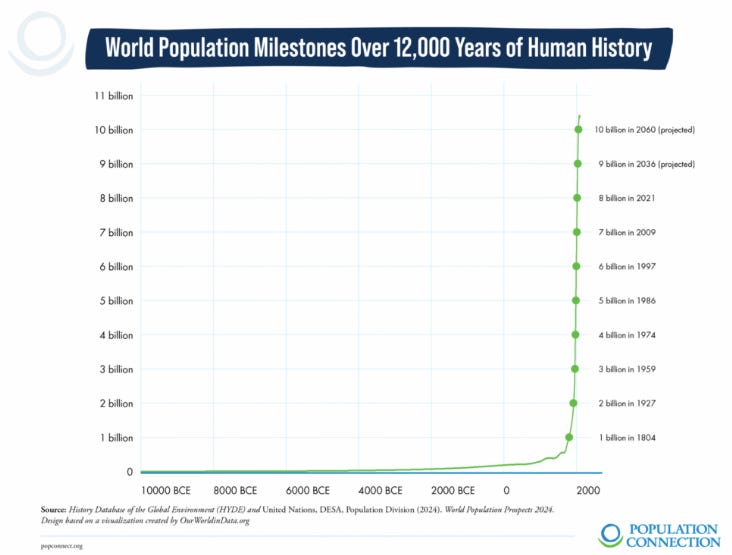
This is not a historical relationship but a structural one, as the population is reflective of the energy that is available to support it; the population will fall without the energy subsidy to maintain it. This will not occur because we will suddenly “run out of food” but more so because: the economic systems that serve to organise and deliver the food through complex transportation and supply chains will become increasingly non-functional; the fertilisers that provide the nutrients for plant growth and densification will become more expensive and scarce; the transportation systems that move the food from fields to processing plants and then to cities and homes across the planet will become less reliable; and the refrigeration that allows just-in-time supply chains to preserve the food will also become less reliable.
The idea that we might “manage” such a decline rather than simply experience it is rather presumptuous, given the motivations of the ruling elite. This class of people profit immensely from status quo arrangements and have no incentive, in fact quite the opposite, to facilitate a managed decline. The wealth, power, and status of the upper echelons of society’s hierarchical structures rely greatly upon continuation of growth regardless of costs, and they will resist any attempts to address ecological overshoot. Again, this is structural; it is not a conspiracy. Those who benefit from a particular arrangement of society will naturally resist alterations that undermine their standing in society. So not only is any management of our simplification difficult to implement because of biophysical limitations, it will be actively opposed by those in our societies that might have the ability to help implement many of the necessary changes.
Let me be clear about where I stand since the structural analysis I have engaged in could lead one to hold that despair may be the only option at this point. I personally believe individual actions such as localisation, community resilience-building, and preservation of knowledge and skills are still meaningful, and worthwhile endeavours, although it’s important to recognise that such efforts will not “save” modernity since they will be overwhelmed by structural constraints. Individual or community gardens will not replace industrial agriculture that feeds 8+ billion, and local trade networks cannot prevent the collapse of long-distance supply chains. There is only so much individual agency and it exists within much larger and more complex systems that will determine the range of possible outcomes for our societies and all of their people. Acknowledging this is realism, not defeatism.
I’m not arguing in favour of passivity or despair; I’m suggesting we have an honest discussion about and gain perspective on, the scale of our predicament and the limits of individual–even group–action within the structural contexts that we are acting within. An accurate assessment of what is possible and what is not is the best means of identifying strategic actions that might help mitigate our situation.
It’s uncomfortable to acknowledge this and it’s pretty tempting to look away. Through a variety of defence mechanisms, we humans tend to avoid anxiety-provoking thoughts–typically via the creation of salvation stories to assure ourselves that all is well. But I would contest that we need to entertain such thoughts if we are to better understand our predicament and discuss how some mitigations and harm reductions might be implemented; and perhaps even act upon them. For example, if we can acknowledge that our population will decline as our energy subsidy declines, we might consider how we might best “manage” this in as orderly and humane a way as possible–especially for the most vulnerable–and how we might preserve the knowledge and skills that could be lost from this die-off. And perhaps the most appropriate way to help us face this is to accept that this is not a problem that can be “solved” but is a predicament that might at best be “managed” somewhat.
The Geopolitics of Decline
The globe’s geopolitical landscape will shift as oil production plateaus and then begins to decline. These shifts will be a combination of somewhat predictable as well as alarming changes. We have already been witnessing signs of these transformations for years and they appear to be occurring more frequently and in more severe ways.
As I have said, oil is a master resource for our societies; it is also a strategic one for nations states from a geopolitical perspective and has long shaped state conduct. The United States, for example, has spent enormous resources–both diplomatic and military–in attempts to ensure its access to oil. In 1980, not long after the 1973 Oil Crisis and the 1978–79 Iranian Revolution, the U.S. implemented the Carter Doctrine, which stated that any outside force that attempted to gain control of the Persian Gulf and impinge upon U.S. access to oil would be considered an assault on the vital interests of the nation and repelled “by any means necessary, including military force”. U.S. intervention in the Middle East has been almost non-stop since; in fact, it can be argued that the U.S. has been intervening in Middle Eastern politics since long before the Oil Crisis–the 1953 CIA- and MI6-backed coup of the democratically elected government in Iran being one of the earlier examples–a coup likely motivated by investment losses following Iran’s nationalisation of the Anglo-Iranian Oil Company in 1951, in which the British government was the majority shareholder.
The competition for what remains of global oil reserves as they dwindle and become more expensive is already intensifying. This is likely to become more common and increasingly aggressive as time goes on and resources become even more dear. Alongside the already fraying hegemony of the U.S., the global order is sure to become progressively chaotic as shifts in our energy foundation worsen.
It’s possible, at least for a short time, that oil-exporting nations will find themselves in an enviable position of increasing global power relative to oil-importing nations. Power of this nature may result in oil-exporters being able to dictate terms, demand concessions, and leverage oil resources for political advantage. However, these nations also face declining oil production as their fields age and reserves become depleted, and any power gains will be relatively brief and ultimately hollow since they too rely on the same finite resource. Their populations and economies will suffer in the same sense that oil-importing states will, just a bit later in time.
All nations will face increasing economic pressure as the cost of energy rises and its availability becomes less reliable. Economic dislocations will be severe and social unrest is likely to become widespread. The world’s governing institutions will be challenged in ways that they rarely have been, perhaps never have been.
This transition from increasing energy availability at a relatively inexpensive cost to one of decreasing availability with much higher costs will very likely not be smooth or managed; it will in all likelihood be disruptive, chaotic, and potentially violent. We have entered a period of increasing resource conflict that will characterise the coming years and decades.
The Fungibility Fallacy
Let me now address some of the magical thinking I encounter on a regular basis: the idea that we can simply “transition” from hydrocarbons to alternatives because of energy’s fungibility. But energy is not fungible in the way money is; you can’t simply swap a unit of oil for a unit of electricity and expect the same results. Different energy carriers exhibit significantly different physical properties and the energy density of oil–the amount of energy stored in a given volume or weight–is of extreme importance. To have electricity replace oil, the energy must be stored in batteries (that exhibit lower energy density) or generated on the spot which requires a continuous power source or storage–both of these requirements have their own limits and costs.
Then there’s the inertia of the existing infrastructure that has been built around oil and its properties. Transportation. Agriculture. Industry. Cities. All of these have been optimised for liquid hydrocarbon fuel with high energy density and very convenient handling properties. To shift away from oil would require rebuilding almost everything at enormous cost and over an extended period of time. We simply have neither the time nor the material and mineral resources to carry out this transition.
The transition narrative also assumes that we would have a sufficient quantity of alternatives readily available, at a reasonable cost, and without negative side effects. The material and mineral requirements for such a buildout are staggering, with the mining, processing, and manufacturing required consuming massive quantities of energy, producing significant amounts of toxic waste, and needing decades to achieve. The costs would be measured in many trillions of dollars and would entail significant ecological degradation.
Even prior to any manufacturing of renewables or other alternative energy technologies, hydrocarbon inputs are massive. Mining relies upon diesel-powered excavators, haul trucks, and processing equipment; refining relies on intense heat typically generated by natural gas or coal, and chemical processes derived from hydrocarbons; transporting materials from mines to processing facilities and then manufacturing plants is all performed by ships, trains, and trucks run on heavy fuel oil, diesel, or bunker fuel. Every stage of this supply chain is dependent upon hydrocarbons, with each consuming energy–energy that should, but often isn’t, accounted for when assessing transition costs.
So, the infrastructure required for this transition is not the product of a post-hydrocarbon world; it is a direct product of hydrocarbons. Its existence entirely depends upon the continued availability of the resource it is supposedly replacing. An honest assessment would be that this idea is an elaborate subsidy, not a transition.
Hydrocarbons are also rarely considered in the manufacturing and deployment stage of the transition. The manufacture, transport, installation, and maintenance of the infrastructure itself requires hydrocarbons. Panels don’t manufacture themselves, but are manufactured in factories powered by hydrocarbons. They are transported by ships and trucks fuelled by hydrocarbons. And they are installed by workers driving hydrocarbon-fuelled vehicles. We are not talking about a replacement system; we are talking about a supplementary system that depends entirely upon the hydrocarbons it is said to be replacing. This hidden subsidy allows the transition narrative to seem plausible, but it is also the flaw that makes the narrative ultimately unsustainable.
So, the transition narrative is not merely overly optimistic; it is a category error. It confuses a supplement for a replacement, a dependency for independence, and a temporary subsidy for permanence. Until we acknowledge this misunderstanding, the talk of a transition remains a comforting fiction allowing humanity to avoid the anxiety-provoking truth that our global, industrialised, complex societies are constructed upon a finite foundation that is crumbling.
And the buildout of renewables and other alternatives over the past several decades has been occurring during a time when total “oil” production was slowing towards its apparent recent plateau, but was still growing–even coal use worldwide has been increasing. It’s difficult to argue that these alternatives have been replacing anything. The data suggest that they have been additive to hydrocarbon use since we continue to increase our total energy consumption, year after year–accelerating our progress toward the ecological cliff.
All the above lays out the evidence. What follows is my attempt to make sense of what it all means.
Conclusion: The Unavoidable Reckoning
I need to go back to the beginning of my journey into the rabbit hole of peak oil–that jarring viewing of Collapse more than 15 years ago–since it frames much of what follows. It was at that juncture that I began watching our species with a mix of bewilderment and a strange, sorrowful awe. The harder I have looked at the hydrocarbon question, the more I have viewed it as one of the most central features of our present predicament. It is a reflection of the Maximum Power Principle (MPP) that has been driving our actions–humans are not necessarily being malicious but optimal; or should I say, the system of which we are a part is operating according to its design. Recall, the MPP selects for systems that maximise energy transformation and humans are the agents of such selection; we’re not necessarily the villains in this story but we are certainly the vehicles. Regardless, the outcome does not change.
Humans have constructed a complex, industrial civilisation upon the back of a finite resource that is now beginning to decline in availability. We leveraged that energy resource to support a population and level of societal complexity that cannot possibly be sustained without this energy subsidy. Additionally, our global economy, that helps to organise and keep goods flowing across the planet, has become dependent upon ever-increasing rates of oil extraction that cannot be maintained. And into the very fabric of our consciousness we have woven the denial of these facts through narratives that our “successes” are attributable to our ingenuity and technological capabilities.
The unfolding and building consequences of this predicament are no longer hypothetical and can be seen every day. Economic disruptions. Social unrest. Ecological degradation. Resource conflicts. These are all manifestations of the physical reality that we are approaching the biophysical limits of hydrocarbons and its capability to continue supporting our complexities. And what have we done to prepare? We’ve woven comforting narratives that everything is fine; there’s nothing to worry about because we are so smart.
I no longer pen these Contemplations with the hopes of persuading others to view the world differently, especially techno-optimists and cornucopians. Beliefs don’t tend to be based upon evidence; they tend to be founded upon faith, hope, and a psychological need to reduce anxiety-provoking thoughts–the denial mechanisms I’ve explored in much of my writing.
I also don’t write them with the expectation that humanity will collectively come to its senses and work towards avoiding the impending collapse of our societies. There’s simply too much evidence of our capacity for denial, our tendency toward magical thinking, and the structural forces that have locked us into a destructive trajectory.
Maybe the most dangerous aspect of our denial is the magical thinking that takes place–the belief that our wishes can alter reality and suspend the laws of thermodynamics–if we believe hard enough or vote better, humanity can be saved. Our typical salvation narrative involves technology, but what we fail to comprehend is that there exist hard, physical constraints that such technology must operate within and this severely limits what they can accomplish.
Nowadays, I think, I write to bear witness to our ever-evolving journey. To lay out my case by describing as clearly and honestly as I can our predicament. I am attempting to offer a framework to help us understand what is occurring, regardless of whether or not that leads to any behavioural change.
Our hydrocarbon age is drawing to a close, and with it the era of growth that it helped make possible. The global, industrial civilisation it helped to construct is also coming to an end, and perhaps all that is left to ponder is whether this will be a long, drawn-out affair or a briefer and more chaotic unwinding.
It could be somewhere in between these two polemical possibilities where we will experience a cascade of interacting crises leading to the stripping away of our civilisational complexities layer by layer. Population decline. Institutional failure. Resource scarcity. Etc. Those systems we have taken for granted will simply cease to function as we have come to expect, and our societies will increasingly simplify.
Most of our species will continue to celebrate the forces that have led to this situation throughout the long emergency, chanting for more growth and progress, believing that “solutions” are just around the corner. They will keep dancing towards the edge of the cliff just ahead while being encouraged by the ruling elite profitting from the false narratives–elites, who as Tainter observed, respond to the situation by intensifying the very strategies that led to the decline and extracting ever more from a planet reeling from our behaviours.
That those best positioned to initiate some form of a managed decline are also those least willing to do so is the tragic irony of our predicament, mostly because their power depends on the status quo systems that are destroying everything. And as Tainter’s framework suggests, our civilisational structures have become interlocked and not amenable to change; their supposed resilience has become their fatal flaw.
It seems we are exactly what our evolution made us: intelligent enough to create a globally spanning and exceedingly complex civilisation, but not intelligent enough to recognise its limits and take the actions necessary to sustain it. With the help of denial that is wired directly into our cognitive abilities, we are a species that cannot face its own limits.
The party continues to rage, but the music is about to stop, and when it does, we will have to face the silence and the mess we have created. Perhaps in that moment we will confront the truths that we have been long avoiding. My money, however, is on us continuing to be in full denial.
Publications of relevance for those wishing a deeper engagement with the source material:
10:1 calorie ratio in industrial agriculture
Pimentel, D., & Pimentel, M. (2008). Food, Energy, and Society (3rd ed.). CRC Press.
Pimentel, D., Hurd, L. E., Bellotti, A. C., Forster, M. J., Oka, I. N., Sholes, O. D., & Whitman, R. J. (1973). Food production and the energy crisis. Science, 182(4111), 443–449. [https://doi.org/10.1126/science.182.4111.443]
Soil degradation from agrochemicals
Gomiero, T. (2016). Soil degradation, land scarcity and food security: Reviewing a complex challenge. Sustainability, 8(3), 281. [https://doi.org/10.3390/su8030281]
Elite resistance to managed decline
Tainter, J. A. (1988). The Collapse of Complex Societies. Cambridge University Press.
Motesharrei, S., Rivas, J., & Kalnay, E. (2014). Human and nature dynamics (HANDY): Modeling inequality and use of resources in the collapse or sustainability of societies. Ecological Economics, 101, 90–102. [https://doi.org/10.1016/j.ecolecon.2014.02.014]
Rees, W. E. (2014). Avoiding collapse: An agenda for sustainable degrowth and relocalization. In State of the World 2014 (pp. 93–102). Island Press.
Loss of traditional agricultural knowledge
Altieri, M. A., & Nicholls, C. I. (2017). The adaptation and mitigation potential of traditional agriculture in a changing climate. Climatic Change, 140(1), 33–45. [https://doi.org/10.1007/s10584-013-0909-y]
FAO. (2019). The State of the World’s Biodiversity for Food and Agriculture. Rome: Food and Agriculture Organization of the United Nations.
Limits of individual action within systemic collapse
Rees, W. E. (2020). Ecological economics for humanity’s plague phase. Ecological Economics, 169, 106519. [https://doi.org/10.1016/j.ecolecon.2019.106519]
Bendell, J. (2018). Deep adaptation: A map for navigating climate tragedy. IFLAS Occasional Paper 2. University of Cumbria.
Mineral requirements for energy transition
Sovacool, B. K., Ali, S. H., Bazilian, M., Radley, B., Nemery, B., Okatz, J., & Mulvaney, D. (2020). Sustainable minerals and metals for a low-carbon future. Science, 367(6473), 30–33. [https://doi.org/10.1126/science.aaz6003]
Michaux, S. P. (2021). The Mining of Minerals and the Limits to Growth. Geological Survey of Finland, GTK.
Synchronous failure of global systems
Homer-Dixon, T., Walker, B., Biggs, R., Crépin, A. S., Folke, C., Lambin, E. F., … & Troell, M. (2015). Synchronous failure: The emerging causal architecture of global crisis. Ecology and Society, 20(3), 6. [https://doi.org/10.5751/ES-07681-200306]
Thermodynamic limits to technology and substitution
Hall, C. A. S., & Klitgaard, K. A. (2018). Energy and the Wealth of Nations: An Introduction to Biophysical Economics (2nd ed.). Springer.
Murphy, D. J., & Hall, C. A. S. (2010). Year in review — EROI or energy return on (energy) invested. Annals of the New York Academy of Sciences, 1185(1), 102–118. [https://doi.org/10.1111/j.1749-6632.2009.05282.x]
Psychology of climate denial
Stoll-Kleemann, S., O’Riordan, T., & Jaeger, C. C. (2001). The psychology of denial concerning climate mitigation measures: Evidence from Swiss focus groups. Global Environmental Change, 11(2), 107–117. [https://doi.org/10.1016/S0959-3780(00)00061-3]
Norgaard, K. M. (2011). Living in Denial: Climate Change, Emotions, and Everyday Life. MIT Press.
Special Offer
If you have made it to the end of this Contemplation, I have an offer for you. Send me an email at olduvaitrilogy@gmail.com requesting a copy of Part 1 of my trilogy and I’ll fire off a PDF of it to you for your “fictional” reading pleasure. If you like the beginning of the tale, please consider ordering the trilogy here: Purchase Book(s) — Olduvai.ca.
What is going to be my standard WARNING/ADVICE going forward and that I have reiterated in various ways before this:
Only time will tell how this all unfolds but there’s nothing wrong with preparing for the worst by ‘collapsing now to avoid the rush’ and pursuing self-sufficiency. By this I mean removing as many dependencies on the Matrix as is possible and making do, locally. And if one can do this without negative impacts upon our fragile ecosystems or do so while creating more resilient ecosystems, all the better.
Building community (maybe even just household) resilience to as high a level as possible seems prudent given the uncertainties of an unpredictable future. There’s no guarantee it will ensure ‘recovery’ after a significant societal stressor/shock but it should increase the probability of it and that, perhaps, is all we can ‘hope’ for from its pursuit.
If you have arrived here and get something out of my writing, please consider ordering the trilogy of my “fictional” novel series, Olduvai (PDF files; only $9.99 Canadian), via my website or the link below — the “profits” of which help me to keep my internet presence alive and first book available in print (and is available via various online retailers).
Attempting a new payment system as I am contemplating shutting down my site in the future (given the ever-increasing costs to keep it running).
If you are interested in purchasing any of the 3 books individually or the trilogy, please try the link below indicating which book(s) you are purchasing.
Costs (Canadian dollars):
Book 1: $2.99
Book 2: $3.89
Book 3: $3.89
Trilogy: $9.99
Feel free to throw in a “tip” on top of the base cost if you wish; perhaps by paying in U.S. dollars instead of Canadian. Every few cents/dollars helps…
https://paypal.me/olduvaitrilogy?country.x=CA&locale.x=en_US
If you do not hear from me within 48 hours or you are having trouble with the system, please email me: olduvaitrilogy@gmail.com.
You can also find a variety of resources, particularly my summary notes for a handful of texts, especially William Catton’s Overshoot and Joseph Tainter’s Collapse of Complex Societies: see here.
Fantastic article yet again thanks Steve
OMHO , Sometime in the near future oil exporters will start thinking about the future and limiting exports , the USA , Russia , and a few other countries in the mid east could easily decide to keep their lights on and the rest of the world go hang .